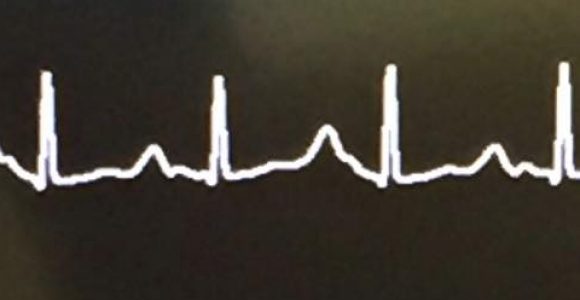

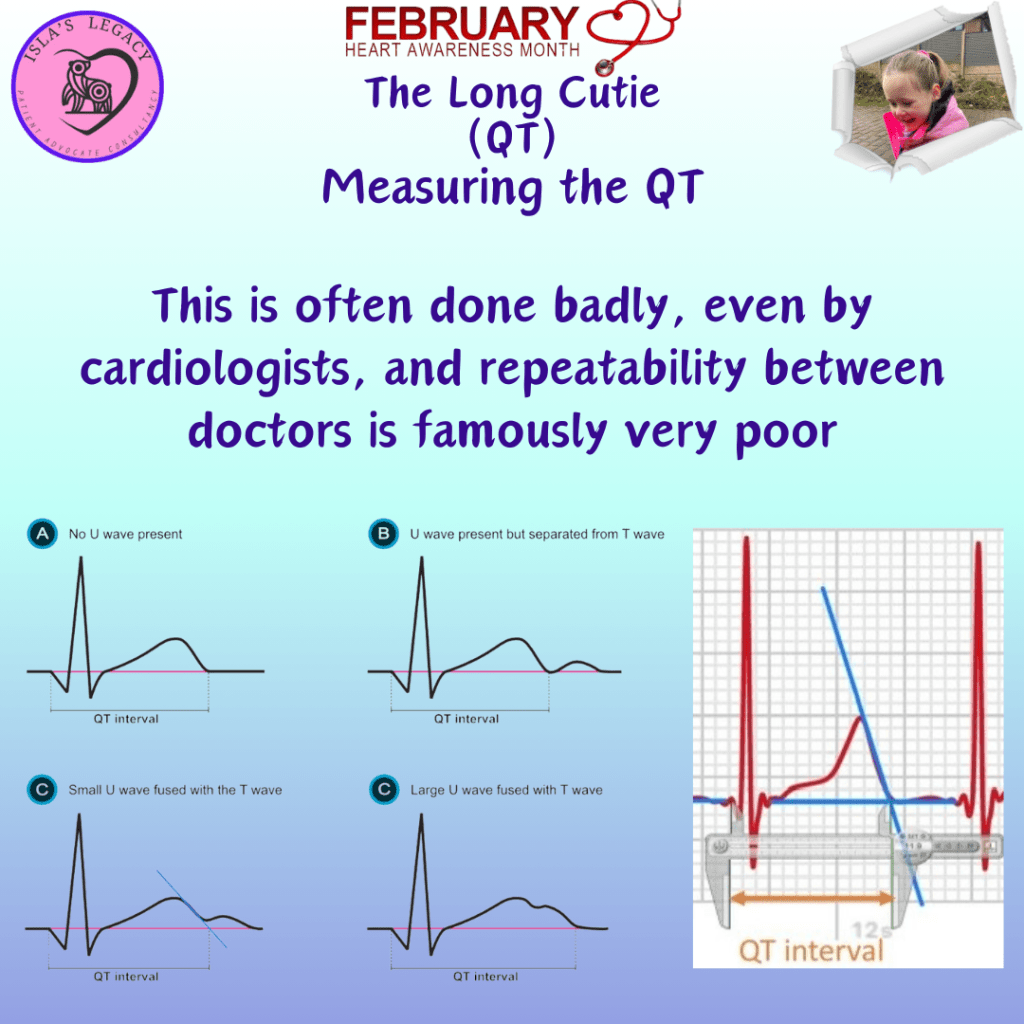
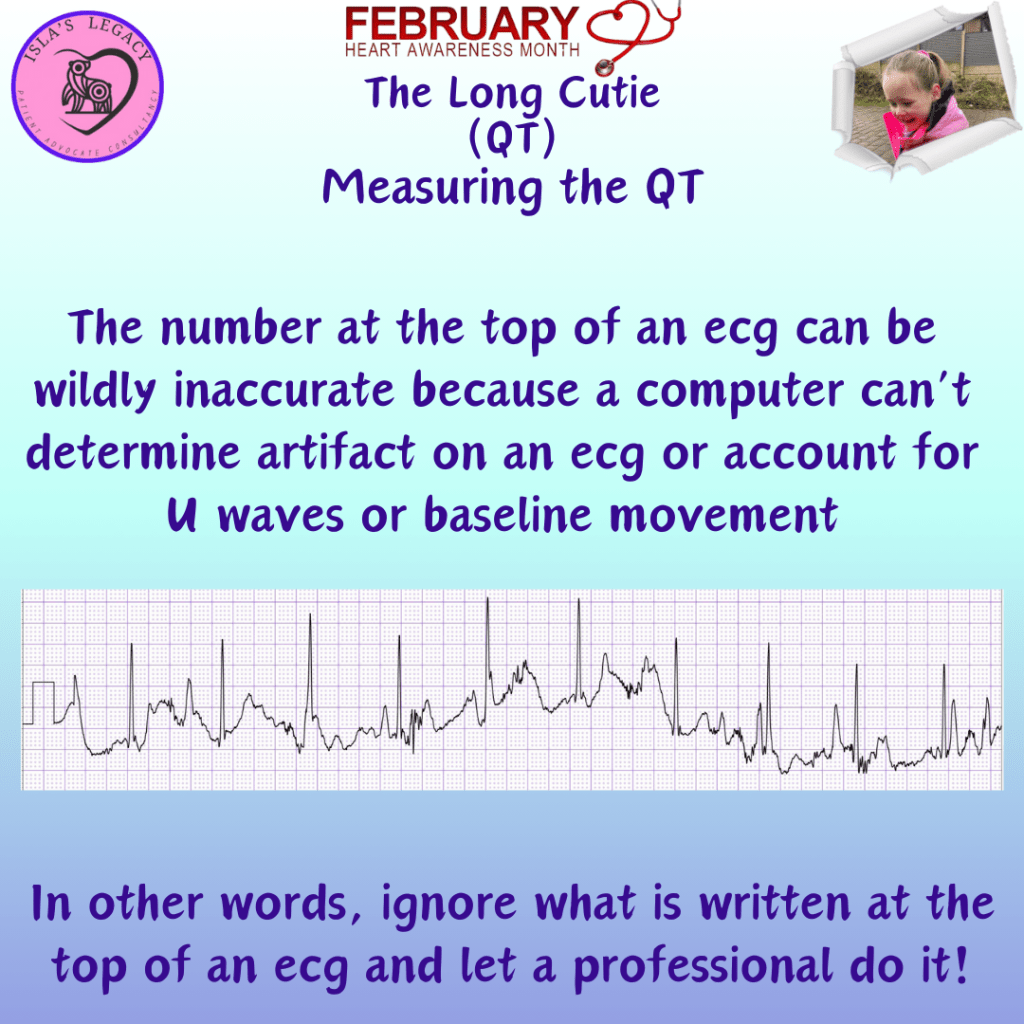
Lots of people see the QT/QTc at the top of an ecg and panic when they see the number. There is really no need to. 9 times out of 10 that number is nonsense. The computer interpretation cannot discount anomalies on a trace and will record the longest gap between where it thinks the Q wave starts and it thinks the T wave ends. As you can see from picture 1 that isn’t always so simple, and picture 2 highlights the trouble that it may have in even identifying the waves.
In a 2005 study the ECGs of two patients with LQTS and two healthy females were presented to 902 physicians (25 world-renowned QT experts, 106 arrhythmia specialists, 329 cardiologists, and 442 noncardiologists) from 12 countries. They were asked to measure the QT, calculate the QTc and determine whether the QT is normal or prolonged. For patients with LQTS, >80% of arrhythmia experts but <50% of cardiologists and <40% of noncardiologists calculated the QTc correctly. Underestimation of the QTc of patients with LQTS and overestimation of the QTc of healthy patients were common. Correct classification of all QT intervals as either “long” or “normal” was achieved by 96% of QT experts and 62% of arrhythmia experts, but by only <25% of cardiologists and noncardiologists. The conclusion of the study found most physicians, including many cardiologists, cannot accurately calculate a QTc and cannot correctly identify a long QT. (Viskin)
There is also the fact that ECG machines automatically calculate the QTc using the Bazett formula. The gold standard for calculating the QTc is now done using the Fridericia formula (QTc = QT / RR1/3). Newer methods such as the Rautaharju formula, QTc = QT * (120 + HR) / 180, or using a QT nomogram are emerging but currently it is still the formulas devised in the 1920s (Bazett and Fridericia) which hold the most stock. Measuring the QT interval really is a minefield so asking a random person off Facebook to interpret an ecg that you took a picture of and uploaded as a low-resolution image on a group, probably won’t give you a very accurate calculation.
Long story short, see an expert, it’s why they are there.
 The Long Cutie