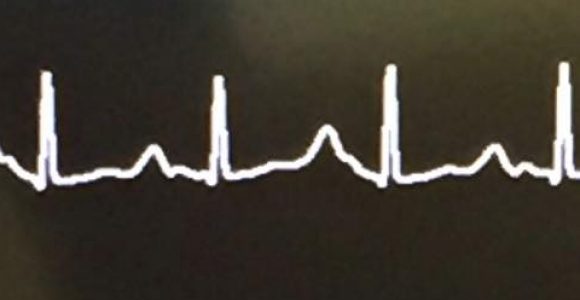

Long QT is considered a rare disease affecting anywhere between 1 in 2000 (@the_bhf ) and 1 in 7000 (@nihgov ) . In the United States it results in about 3,500 deaths a year. Long QT was first clearly described by Jervell and Lange-Nielsen in 1957 so relatively speaking it is a fairly new disease we are still learning more about. There are two forms of congenital LQTS: Jervell and Lange-Nielsen syndrome and Romano-Ward syndrome.
Romano-Ward syndrome is the most common form of congenital long QT syndrome, which purely affects cardiac ion channels to produce prolonged QT interval. It does not affect any other systems unlike Jervell and Lange-Nielsen syndrome. It is inherited in an autosomal dominant fashion which means that one parent with the culprit gene is sufficient to produce an affected child.
Jervell and Lange-Nielsen syndrome is a condition that causes profound hearing loss from birth, in addition to causing prolonged QT interval. Jervell and Lange-Nielsen syndrome is uncommon; it affects an estimated 1.6 – 6 per 1 million people worldwide. This condition is inherited in an autosomal recessive pattern, which means that both parents must be carrying the culprit gene in order to have an affected child (credit @cardiacriskintheyoung )

 The Long Cutie